Day 01 : Delhi / Haridwar / Rishikesh
AM TFR to RLY station to board shatabdi exp (fast train) to haridwar (A
bigger town near rishikesh with 30 minutes drive). O/n at hotel.
Day 02 : Rishikesh / Okimath (Drive 6/7 hrs)

AM
B/F & Drive to Okimath enroute visiting devprayag & rudraprayag.
Arrive okimath, the winter seat of lord kedarnath. Eve visit the okimath
temple and market of small hill town. O/N at Guest House.
Day 03 : Okimath / Devriatal / Sari (Trek - 5/6 hrs.)
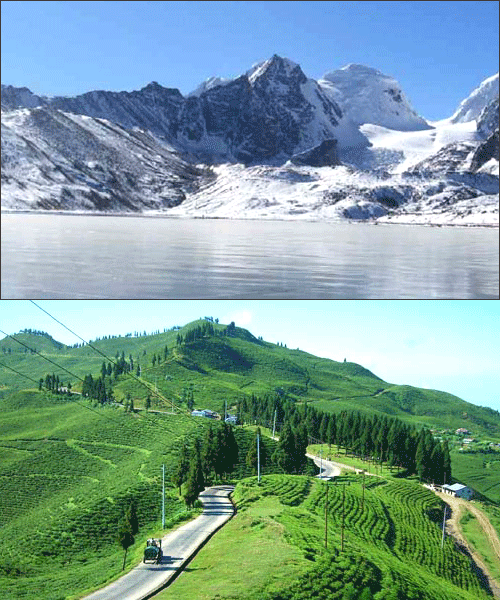
AM B/F Trek to Devriatal, one of the finest Himalayan lakes. On arrival
enjoy the panoramic view of greater himalayan range explore the area and
trek down to sari. Arrive sari & o/n at camp.
Day 04 : Sari/ Chopta/ Tungnath (Trek - 5/6 hrs.)
AM B/F & Trek to chopta. After lunch at chopta trek to tungnath,
one of the most important shiva temples in the area. Arrive tungnath &
O/N at camp.
Day 05 : Tungnath
Day free at Tungnath to explore the surroundings, photography. Night
stay at camp.
Day 06 : Tungnath / Chopta/ Rudraprayag. (Trek 2-3 hrs. & 5-6
hrs. drive)
AM B/F & Trek down to chopta. Arrive chopta and drive to
Rudraprayag, through the musk deer sanctuary. Arrive rudraprayag &
transfer to hotel.
Day 07 : Rudraprayag
Full day free at Rudraprayag, Rudraprayag is famous for confluence of
two Great rivers Mandakini and Alaknanda. Explore the surroundings.
Night stay at Rudraprayag.
Day 08 : Rudraprayag / Srinagar (Raft 5-6 hrs.)
AM B/F & Raft down till Srinagar, the old capital of garhwal. We
raft down through the gorge and remote villages. Arrive srinagar o/n at
camp.
Day 09 : Srinagar / Devprayag (Raft
4-5 hrs.)

AM after B/F raft down till devprayag. Today we float past the villages
and old temples of the area. Arrive devprayag visit the ancient temple
of ragunath. O/n at camp.
Day 10 : Devprayag / Kaudiyala (Raft 5-6 hrs.)
Today we float past remote villages. Lunch at byas ghat the anglers
paradise, is famous for golden mahasheer fish. O/n at camp.
Day 11 : Kaudiyala
Morning and afternoon session for Rock Climbing. Night stay at camp.
Day 12 : Kaudiyala/Brahmpuri/ Rishikesh (Raft 6-7 hrs.)
Today we hit most of the exciting rapids on the ganga. Arrive Brahmpuri
and camp. O/n at camp.
Day 13 : Rishikesh/ Chila
Leave Rishikesh to Chila wildlife sanctuary. Arrive Chilla check into
the hotel. Evening free to visit the sanctuary. Night stay at Chilla.
Day 14 : Chila
Full day free at Chila visit Inside the wildlife sanctuary and enjoy
Elephant ride. Night Stay at Chilla.
Day 15 : Chila
Full day free at Chila visit Inside the wildlife sanctuary and enjoy
Elephant ride. Night Stay at Chilla.
Day 16 : Chilla/Corbet National Park
Drive to Corbet :Afternoon visit Jungle for game viewing. Evening at
leisure. O/N at Hotel.
A Peak Inside The History Of The Park

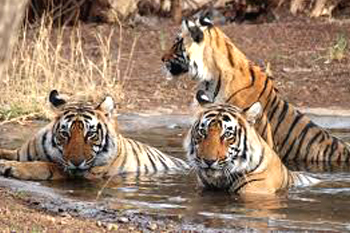
The Corbett Tiger reserve has quite a history. It is India's First
National Park and one of the finest, notable for its individualistic
scenic charm and magnificent submontane and riverine vistas, and also
for its richly varied wildlife, still interestingly in the process of
change, and the site of the launching of project Tiger.
Early this century its exceptional potential as a wildlife reserve was
recognized and there were moves to have it officially declared a
sanctuary, liberating it from the exploitation of its tree forests and
human occupation of the riverside land. Finally, in 1936 it was set up
as the first authentic national park of the country under the United
Provinces National Parks Act.
The Renaming Process
Originally, it was named the Hailey National Parks Act after Sir
Malcolm Hailey, the Governor of the united provinces, who took such a
keen interest in its development as a preserve. After Independence it
was renamed the Ramganga National Park, and later still the name was
again changed to the Corbett National Park this last change, it should
be noted, was not solely in commemoration of the late Jim Corbett, the
famous slayer of man eaters in the sub Himalayan forests, but also in
recognition of his services in determining the location and limits of
the proposed national park before it was set up he had been consulted
over this as an expert. Jim Corbett- hunter of man-eating Tigers,
photographer, conservationist and author was born in Nainital of English
and Irish parentage. A childhood spent around the Corbett winter home of
Kaladhungi brought young Jim into close communion with nature, and to an
instinctive understanding of jungle ways. After working on the
railways, he joined the Indian army in 1917 at the age of forty; he rose
to the rank of Lieutenant Colonel, and saw action in Flanders at the
head of the 70th Kumaon Company.
The Savior - Jim Corbett
Known locally as "Carpet Sahib", a mispronunciation of his
name, Jim Corbett was called upon time and time again to rid the hills
of Kumaon of man eating Tigers and Leopards. Normally shy of human
contact, such animals become man eaters when infirmity brought upon by
old age or wounds renders them unable to hunt their usual prey many of
those killed by Corbett were found to have suppurating wounds caused by
Porcupine quills embedded deep in their paws; Tigers always seem to fall
for the Porcupine's simple defensive trick of walking backwards in line
with its lethal quills.
Adventures Of Corbett
One of Corbett's most memorable exploits was the killing of the
Rudraprayag Leopard, which accounted for 125 human lives between 1918
and 1926, and was bold enough to steal its victims from the midst of
human habitation; he also terminated the careers of the Chowgarh
Tigress, the Talla Des and the Mohan man eaters.
Corbett described his adventures in books such as my India, Jungle Lore
and Man Eaters of Kumaon; Martin Booth's Carpet Sahib is an excellent
biography of a remarkable man. Awarded the order of the British Empire
in recognition of his lifelong work with nature, Jim Corbett was unhappy
in post Independence India, and left to settle in East Africa.
Project
Tiger
On April 1, 1973, Project Tiger was inaugurated here. This ambitious
project aims at saving and reviving the alarmingly dwindled Indian Tiger
(Panthera Tigris Tigris) by setting up specially selected reserves of
adequate area in which not only the Tiger but also all other animals and
the wild flora, would be totally conserved, such total conservation with
no selective bias, depending on the ability of nature of maintain its
own balance, being much the best way to rehabilitate any animal, as part
of a whole wildlife complex. In 1973 there were 8 such reserves under
the project, and the Corbett Tiger Reserve was the first of these.
As in all other reserves of the project, here too the main part is
constituted into a core area meant exclusively for the wild fauna and
flora, where there is no human disturbance and around this core is the
insulating buffer zone, in which a part is allotted to tourism. Prior to
1973 Dhikala had been developed to provide accommodation and facilities
to see the wildlife, to visitors to the National Park; it is still the
main centre of tourism.
Day 17 : Corbett
Full day free for Elephant ride, Jeep safari inside the Corbett
National park. Night stay at hotel.
Day 18 : Corbett
Full day free for other jungle activities inside the CORBETT NATIONAL
PARK like bird watching, Tiger Spotting etc. Night Stay at Corbett.
Day 19 : Corbett To Delhi
Drive from Corbett to Dehradun and from Dehradun/Rooop Nagar drive to
Delhi, arrive Delhi...........Tour end with happy memory.